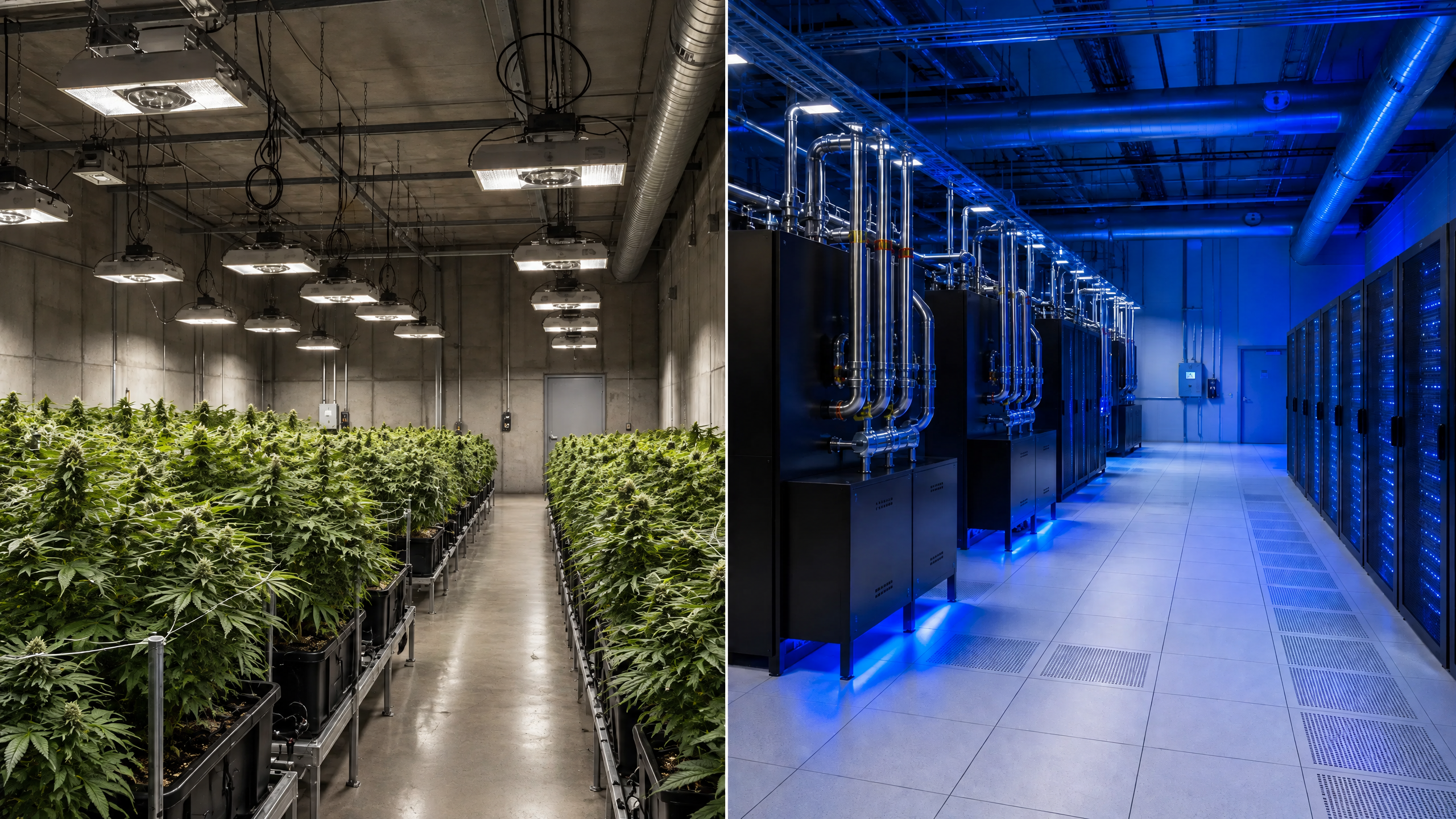
The same AI hardware.Your data stays in the building.
Gigawatt campuses are built to rent AI to the whole market. Many organizations need the same computing power on a smaller scale—and can’t send their files out.
UNICANN turns a powered indoor cannabis grow into a private AI node of up to 5 MW.
Looping animation: an indoor grow room with lights and plants goes dark, AI server racks move into the same building on the same electrical service, and files stay inside the building instead of going to a public cloud. Then it starts again.
Billions are going into gigawatt campuses built to rent AI to everyone. For many AI workloads, the power already exists inside indoor grows.
1 of 3
The power is already there.
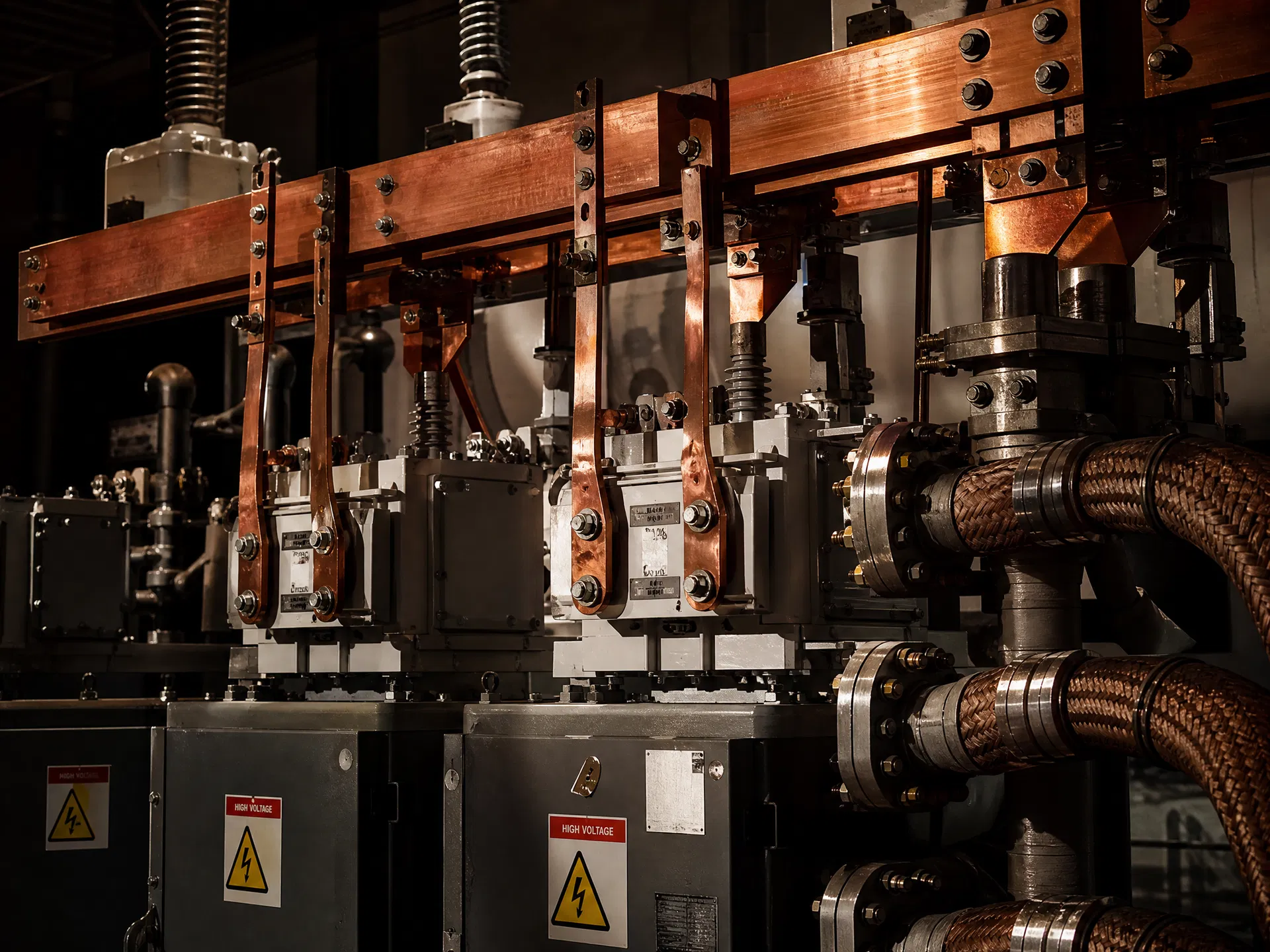
Indoor grows were built to run megawatts of lights and cooling. The lights come out. The heavy power service stays. You don't have to fight for a new 100 MW substation.
With closed-loop cooling, onsite water use can drop sharply too.
Run open-weight AI models, fine-tuned on your own files, on hardware you control. A public AI service may cost less per use, but contracts or the law rule it out for some files.
If you only rent an AI app, you don't need a site. If you can run the model yourself, power is the question.
3 of 3
The racks are tenants. The power is the asset.
When faster, more efficient chips arrive, they plug into the same power service. You don't need a new campus, and keeping your data private doesn't leave you a generation behind.
One example (illustrative)
A 40-person machine shop making aircraft parts.
What makes them good is know-how: the toolpaths, the fixtures they already own, and the scrap history in one programmer’s head. None of it can be sent to a public AI service. Sending controlled drawings out can create an export-control problem.
Ten shops like this can share the power without sharing their files.
Clinics, counties, and factories with a secret recipe have the same problem.
Every site still needs utility, engineering, and permit sign-off. See how we check
For owners and infrastructure buyers
Start with a powered building, not an empty lot.
A new data center starts from scratch. A large indoor grow may already have the building and the power. We check whether it can become a 1.5–5 MW AI node.
Building from scratch
Every step starts at zero
1Find land
2Get zoning and permits
3Get a new power line
4Build the building
5Fit out and turn on
Reusing an indoor grow
Can start farther along
Building already there (already done)
Power service already there (already done)
3Check and redesign
4Convert and turn on
Reuse only saves time if the utility, permits, building, cooling, and fiber all check out. That is what we verify.
Choose your path
Which one are you?
We match powered buildings with people whose AI work has to stay private. Pick your side to see if you fit.
1.5–5 MW is the size range we screen for. It is not a promise of usable power or value at any site.
Who actually needs the power
The model determines who needs the power.
One simple question decides it: can you run the AI model yourself?
01 · Closed, vendor-only model
You rent access.
The provider keeps the model weights and runs the GPUs. You use an app or API; you do not need to power the model yourself.
Provider controls the weights
Provider supplies the compute
No dedicated AI site required
02 · Deployable model
You can run it yourself.
The weights are available and licensed for your use—often called open-weight, open source, or privately licensed. You choose where the model runs.
You can possess approved weights
You choose cloud, colo, or owned hardware
Power matters when you operate the compute
When power becomes strategic
Start with the workload—not a megawatt target.
<20 kW
01
One AI server
Useful private inference. No megawatt-scale site needed.
20 kW–<1.5 MW
02
Growing cluster
Several systems with their own networking, storage, cooling, and operators—still short of a dedicated node.
1.5–5 MW
03
Dedicated AI node
Sustained multi-rack capacity for an AI company or regulated enterprise.
A dedicated node is worth considering only when the model is deployable, the workload is sustained, and control matters enough to justify it instead of cloud or ready-to-use colocation.
“Deployable” is used here as plain language. Model licenses vary; open-weight does not always mean open source, and deployment rights must be reviewed for the intended use.
A campus is built for buyers at gigawatt scale. A node is built for organizations whose work can’t leave their control.
Node versus campus
Different jobs, different buildings.
Dimension
Dedicated node
Gigawatt campus
Deployment unit
Dedicated node
A bounded 1.5–5 MW capacity block at one qualified site.
Gigawatt campus
A multi-building, multi-phase platform measured in hundreds of MW or gigawatts.
Primary fit
Dedicated node
Defined production workloads where dedicated control, data locality, or staged capacity matters.
Gigawatt campus
Fleet-scale cloud operations and the largest tightly coupled training programs.
Power path
Dedicated node
May enter through local distribution in a suitable location, subject to utility study and upgrades.
Gigawatt campus
More routinely requires dedicated substations, upstream transmission, and regional large-load planning.
Commercial logic
Dedicated node
Release one customer-defined phase after site, power, technical, and contract gates are met.
Gigawatt campus
Capture scale advantages in standardization, procurement, shared operations, and fleet management.
Power architecture
Power made on site, next to the existing service.
“Behind the meter” means generating power on site, alongside the building’s existing utility service, so the project needs less new capacity from the utility. Pick a setup to see how power flows.
Selected architecture
Grid-parallel behind-the-meter
Onsite generation, storage, or both operate in parallel with the grid and may reduce measured grid imports under defined conditions.
What it can be designed to do
Support an engineered import-management, resilience, or non-export strategy while retaining utility service.
What must be proven
Interconnection, protection, metering, and export settings
Supplemental and standby service treatment
Fuel, emissions, operating limits, and air permits
Boundary: Behind the meter does not mean utility-free, permit-free, off-grid, or exempt from interconnection and tariff requirements.
Interactive one-line concept
Follow the power path.
Select a component to see its role and current state. Animated lines show which paths are energized in the selected setup; control signals are shown separately from power flow.
Grid-parallel behind-the-meter
Swipe horizontally to inspect the full one-line.
Operating state
Grid and onsite resources synchronized
Point of interconnection
Closed
Grid path
Utility remains connected
AI supply
AI load can receive blended site supply
Selected component
Meter + point of interconnection
The electrical and commercial boundary where metering, protection, import/export settings, tariff terms, and operating agreements are defined.
Closed for synchronized parallel operation
Utility / AI powerOnsite generationStorage / control
Power-flow reading
Generation and storage may reduce net import. Directional animation indicates the conceptual energized route, not power quality, capacity, or protection logic.
The upstream grid, feeder, and substation serving the property. A historic industrial connection is a diligence lead, not a capacity reservation. Current state: Connected and supplying net site demand.
Meter + point of interconnection
The electrical and commercial boundary where metering, protection, import/export settings, tariff terms, and operating agreements are defined. Current state: Closed for synchronized parallel operation.
Site distribution bus
The facility-side distribution point that routes power through switchgear, UPS, transformers, and protection before it reaches the computing load. Current state: Combining utility and onsite supply.
Dedicated AI node
The protected computing load after facility overhead, cooling, power conversion, redundancy, and operating margin are accounted for. Current state: Supplied through the grid-connected site bus.
Battery energy storage
Storage can bridge transitions, support controls, and serve a defined load. MW describes instantaneous power; MWh determines duration. Current state: May charge, discharge, or manage import under approved controls.
Onsite generation
Fuel cells, engines, turbines, solar, or another local source may support defined objectives, subject to fuel, emissions, noise, and permit constraints. Current state: Synchronized with the utility under an approved scheme.
Microgrid controller
Controls coordinate synchronization, separation, voltage and frequency, resource dispatch, load shedding, and reconnection. Current state: Coordinates parallel resources and import/export limits.
Workload-qualified
Production inference, applied fine-tuning, private AI, and data-local workflows can fit when the model, data, network, and service objective match the node.
Frontier pre-training is not the primary use for this segment.
Reuse-first, evidence-first
An already-developed industrial shell can be a redevelopment option worth testing against the real computing design.
A cultivation license or historic electrical service does not establish AI readiness.
Phased against proof
An initial capacity block can be defined and commissioned, then expanded only after the next power, design, approval, and demand gates are met.
Phasing limits the amount committed at one time; it does not eliminate risk.
Locally accountable
Claims about water, cooling, onsite generation, noise, land disturbance, permits, taxes, and workforce should rest on project-specific evidence.
Smaller scale does not automatically mean lower impact.
The investment discipline
Build only the phases that are verified and under contract. A smaller first capacity block can limit the capital exposed before later phases, but it does not remove customer concentration, utility, technology, operating, or residual-capacity risk.
This is an educational infrastructure framework—not an offer, an investment recommendation, a utility commitment, an engineering design, a permit determination, an environmental claim, a reliability guarantee, or a projection of cost, schedule, value, or return.
Workload, distribution, reuse, and power-architecture statements are bounded by the cited official and first-party sources. None evaluates a specific cultivation property or establishes site capacity, economics, environmental performance, or approval status.
When credit tightens, the size and structure of an AI project matter as much as the chips inside it. A 1.5–5 MW node changes which risks you carry. It does not remove them.
Oct. 14, 2026 · Markets
Shares and bonds of several AI-infrastructure companies fell sharply as investors grew concerned about how heavily the build-out is being financed with debt. A fixed-income strategist told CNBC that investors are now demanding more compensation for risk.
“More than $3.5 trillion of AI infrastructure spending could be exposed to impairment by the end of 2030, if AI providers continue their current pace of capital spending”
The same release says: “Failure to achieve sustainable ROIC on rapidly depreciating assets would almost certainly necessitate write-downs.”
The mismatch at the center of AI finance
Buildings last decades. Chips last years.
When short-lived hardware and long-lived real estate sit in one debt-financed bundle, a faster chip cycle can strain the whole project. Keeping the layers apart is one way to limit that.
Power infrastructure
25+ years
Building shell
~20 years
AI accelerators
4–6 years
Gen 1Gen 2Gen 3Gen 4
0510152025+ yrs
One building can outlast 3–5 generations of AI chips.
Typical accounting lives, not a forecast for any asset. Each chip bar represents five years.
A node is sized for one organization’s defined AI work and released in phases only after power, design, approval, and contract gates are met. Less capital is committed before a customer signs.
Texas ordered an audit of every data center in its grid queue, and grid operators have struggled with load forecasts inflated by speculative projects.
Doesn’t fix: Relying on one customer concentrates risk. Contracts can end or not be renewed.
02
Keep long-lived and short-lived layers apart
The building and power service last decades; AI chips turn over in years. When the organization running the workload owns and refreshes its own hardware, the site’s shell and power can be valued and financed separately from the chips.
AI accelerators are typically given four to six years of useful life, buildings about 20, and power infrastructure 25 or more.
Doesn’t fix: A contract can shift obsolescence risk to one party, but it cannot eliminate that risk.
03
Start from what already exists
An existing industrial building with heavy power service may face a different local approval path than a raw-land rezoning would. In one 2026 tracker, most canceled projects were stopped at the local-permit stage.
At least $260 billion of data-center investment was canceled in 2026 after sustained local opposition.
Doesn’t fix: A change of use still needs local approval, and opposition can form around any project.
04
Stay far below the largest grid queues
Texas now studies new loads of 75 MW or more together in one batch; in June, ERCOT said it expected the final transmission plan in fall 2027. A 1.5–5 MW node is a small fraction of that threshold and may be served through local distribution.
ERCOT groups large loads of 75 MW or greater into a single Batch Zero study.
These studies cover energy and space programs, not AI data centers. They describe a pattern worth testing, not a proven result for this asset class.
Educational commentary only—not an offer, a recommendation, or investment advice. UNICANN does not comment on or recommend any company’s securities or creditworthiness. News and forecasts are quoted with attribution as of their publication dates; forecasts are their authors’ opinions, not facts, and no source quoted here endorses UNICANN. A smaller node still carries real risk, including the loss of capital committed to it.
Market events are described at the sector level as reported. Quotations are reproduced verbatim from the cited publications. GARTNER is a trademark of Gartner, Inc. and/or its affiliates. Gartner does not endorse UNICANN.
The conversion band
Not a hobby rack.A dedicated node.
Large indoor grows may offer a useful starting envelope: industrial shells, high-capacity service, and heat-rejection infrastructure. None of that automatically becomes AI-ready.
The useful question is whether documented post-shutdown power, site control, cooling design, fiber, fire protection, and local approvals can support a 1.5–5 MW dedicated node.
UNICANN screening band
1.5–5 MW
Dedicated AI nodes—not single servers, not gigawatt campuses.
Entry node
1.5 MW
A dedicated multi-rack starting point when workload and site evidence align.
Core target
3 MW
The center of the screening band for scaled, controlled compute.
Expansion edge
5 MW
More deployment headroom when utility and conversion conditions support it.
What must be proven before hardware
Usable utility power
What the utility will support for the new AI use—load, rate class, ramp, and date.
Complete change of use
Cultivation ceases; ownership, shutdown, and local approval paths are documented.
AI-duty conversion
Cooling, fiber, fire protection, controls, and electrical distribution are redesigned for continuous IT load.
A better alternative
The site must beat cloud, colocation, or another powered location on the buyer’s actual requirements.
Why adaptive reuse is worth testing
Existing infrastructure is a hypothesis—not a shortcut.
A powered industrial shell may shorten one part of the path. It does not prove transferable utility capacity, AI-duty cooling, change-of-use approval, schedule savings, or economics.
Start from zero
Greenfield path
Secure suitable land and entitlements
Enter the utility and equipment queue
Build the full electrical, cooling, fiber, and life-safety stack
Start from evidence
Conversion path
Confirm post-shutdown service and site control
Determine what can be reused versus replaced
Prove the complete conversion beats other powered-site options
Efficiency is not a single number
Accelerator vendors report material performance-per-watt gains, but each result depends on a specific model, precision, runtime, system boundary, and interactivity target. UNICANN keeps those comparisons separate rather than turning them into one universal score.
A dry, closed-loop node can use less onsite water than an operating indoor grow, but its larger electric load can shift water use upstream. Our sourced comparison keeps those ledgers separate and shows the Arizona heat tradeoff.
UNICANN’s private diligence layer is designed to make uncertainty visible—not to manufacture certainty. Each claim stays linked to its evidence state, each match explains its logic, and each report freezes the assumptions used at that moment.
01
Verified Facility Passport
A field-level ledger of recorded facts, evidence state, confidence, blockers, and independent G0–G7 readiness gates.
02
Permissioned Evidence Room
Encrypted document storage with scoped review, expiring record-level grants, revocation, and access history.
03
Explainable Matching
Deterministic buyer-to-facility screening with visible hard gates, criterion contributions, evidence penalties, and stale-data warnings.
04
Frozen Conversion Reports
Reproducible scenario snapshots that separate facility input, IT load, dependencies, alternatives, unknowns, and limitations.
05
Infrastructure Intelligence
Sourced utility, fiber, hazard, permitting, water, and labor factors mapped only at a deliberately coarse level of location detail.
Illustrative workflow
See how a cultivation campus can move from document review through utility, conversion, operations, and phasing gates—without implying a live offer.
What UNICANN does, who it is for, and what still has to be proven for any one building.
What does UNICANN do?
UNICANN connects U.S. indoor cannabis cultivation facilities that already have heavy power service with buyers who need a private, dedicated AI node of about 1.5–5 MW. The grow ends completely, and the building gets a new job. It is not a shared cannabis-and-computing site.
Why reuse an indoor grow instead of building a new data center?
Large indoor grows were built to run megawatts of lights and cooling. When the building and the power service already exist, a project can start farther along than a ground-up build that begins with land, zoning, a new power line, and construction. Whether converting a specific site is actually faster or cheaper depends on its utility documents, building condition, permits, and conversion design.
A private block of AI computing—typically about 1.5 to 5 megawatts for servers, cooling, and networking—run for one organization on hardware it controls, instead of renting capacity on a gigawatt-scale campus built to serve the whole market.
Two groups: organizations that can run open-weight models themselves but whose AI work can’t go to a public cloud because of contracts, regulation, or confidentiality; and owners of powered indoor grows who are exploring a complete change of use.
Does the cannabis business keep operating in the building?
No. Cultivation ends completely and lawfully before conversion work begins. There is no phase where cannabis and computing share the building.
Does an AI node use more or less water than an indoor grow?
It depends on the cooling design and the climate. With dry or closed-loop cooling, onsite cooling water use can be very low; evaporative or hybrid cooling uses more, especially in hot, dry regions. A conclusion about a specific property needs metered data and an engineering review.
UNICANN screens for sites that may support about 1.5–5 MW of usable power after conversion. The utility’s documents and an engineering review determine what is actually usable—the size of the old grow alone does not.
Is a smaller AI node less risky than a gigawatt campus?
Not less risky—differently risky. A 1.5–5 MW node commits less capital at once, can be built for one named workload, and can keep the long-lived building and power infrastructure separate from AI chips that are typically replaced every four to six years. It still carries customer, hardware, financing, utility, and approval risk, and smaller sites give up some economies of scale.
No. UNICANN provides screening information only. Nothing on this site is an offer, a valuation, a guarantee, or legal, tax, engineering, financial, or investment advice.